EMT Practice Test

1. Question Content...


Question List

Question1: You configured a SnapMirror relationship with a default policy for the daily mirroring of a volume which contains financial data. Although the data is critical, it only changes on a monthly basis.
Using On Command System Manager, which two actions would change the frequency of the SnapMirror updates? (Choose two.)

Question2: Which two cloud providers allow you to provision Cloud Volumes ONTAP as a SnapMirror destination? (Choose two.)

Question3: A customer has deployed an 8-Node Fabric MetroCluster solution. In this scenario, what information is replicated by the Configuration Replication Service (CRS) in ONTAP 9.3? (Choose two.)

Question4: You and other administrators are in the habit of creating FlexClone LUNs and then not deleting them when they are no longer needed.
What should you do to help manage space utilization?

Question5: You want to schedule daily differential backups for vault backups and weekly full backups to tape using SnapProtect.
Which policy would you use to configure the Primary (Classic) tape backup?

Question6: Before issuing a MetroCluster disaster-recovery switchback, you must execute the MetroCluster ~heal~ command on the data and root aggregates.
In this scenario, what happens when issuing the ~metrocluster heal -phase root-aggregates~ command?

Question7: A client decided to transition from a NetApp Storage Encryption environment that uses a KMIP-based centralized key management server to a NetApp Volume Encryption environment that uses onboard key management.
Which two steps are required to complete this task? (Choose two.)

Question8: Which two statements describe a Snapshot copy prefix? (Choose two.)

Question9: You want to provide your team with a SnapProtect report that shows how many backups succeeded, were delayed, and failed over the last 30 days. You also want detailed information about the jobs, agents, and clients.
Which CommCell report provides the necessary information?

Question10: Which command shows a volume's space usage, including metadata, within the aggregate?

Question11: You have created a new CIFS share but it is inaccessible. After verifying the export policy, network connectivity, junction path, and permissions are all correct, you realize there is root volume loadsharing mirror in place.
What should you do next to make the share accessible?

Question12: Your customer wants to ensure that the SnapMirror relationships are easily managed in a bidirectional, multi-cluster environment.
Which version of clustered Data ONTAP would you recommend?

Question13: You do not want to impact your ongoing SnapMirror relationship between your primary and secondary site.
Which step must be taken prior to creating a FlexClone at the disaster recovery site?

Question14: What are two NetApp data protection solutions? (Choose two.)

Question15: Which two NetApp ONTAP cluster technologies only replicate the changes to WAFL blocks of a volume? (Choose two.)

Question16: When you configure a SnapLock feature, where should the ComplianceClock be initialized?
Question17: All of your CIFS file shares reside on a single NetApp volume. You are asked to ensure that your files are kept for seven days locally, and for 30 days off-site.
What is the correct solution?

Question18: You want to convert an existing relationship into a version flexible mirror without re-creating a baseline.
What are two ways to accomplish this task using clustered Data ONTAP? (Choose two.)

Question19: A volume has been filled completely by active data and Snapshot copies.
What must you do to make the volume writable again?

Question20: You want to have a NetApp FlexVol that can both grow and shrink dynamically as required by current capacity needs.
Which settings will enable this feature?

Question21: A customer has developed a new application that uses Oracle with an AFF system to help track all of their shipping trucks around the world. The customer wants to ensure that application-consistent backups are offloaded to the cloud.
In this scenario, which two solutions enable the customer to satisfy these requirements? (Choose two.)

Question22: Management wants the ability to transfer more data over a low bandwidth network connection.
Which action would satisfy the request?

Question23: You have deployed volume-level replication with NetApp Synchronous SnapMirror replication technology.
In this scenario, which two statements are true? (Choose two.)

Question24: A client is planning to configure a SnapMirror relationship between two sites. Normally their ISP provides network throughput of 100 Mbps; however, they can arrange to have this burst to 1 Gbps for a period of time at an additional cost.
Their intention is to back up 400 GB of Snapshot data each day using the burst option to keep the replication time to a minimum. In this scenario, how much burst time do they need to purchase?

Question25: The primary and secondary clusters are fully configured. You want to set up an inter-cluster SnapMirror relationship.
Which two actions are prerequisite to accomplishing this task? (Choose two.)

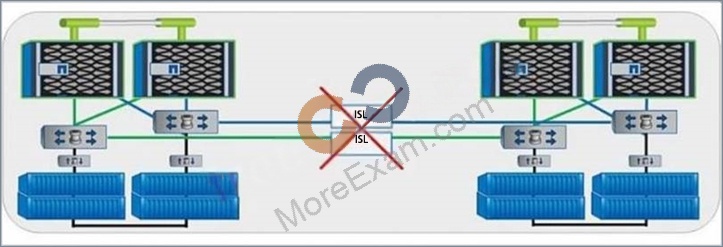
Question26: You are using a clustered Data ONTAP MetroCluster solution without TieBreaker.

Referring to the graphic, what are three consequences if all ISL connectivity is lost? (Choose three.)

Question27: You have enabled the SnapMirror global throttling feature to restrict bandwidth that is used by SnapMirror operations over the network for both incoming and outgoing transfers in ONTAP.
In this scenario, which two statements are correct? (Choose two.)

Question28: What are three OnCommand Workflow Automation building blocks? (Choose three.)

Question29: You have an environment with multiple database servers that are performing scheduled nightly dumps. These dumps vary in both the time to complete and the size of data produced. You need to ensure that there is always enough room in the volume for the data and that a nightly SnapMirror update does not take place until the database dump process is complete.
In this scenario, which NetApp tool ensures that this process is completed every night?

Question30: You are implementing version flexible SnapMirror in a clustered Data ONTAP environment.
Which type of SnapMirror policy would be used?

Question31: A client has two regional offices that use SnapMirror cross-site replication to host disaster-recovery mirrors for both offices. A co-worker at one office is requesting read/write access to one of the volume mirrors. You must accomplish this task without interrupting data access or replication.
In this scenario. how should you proceed?

Question32: Your customer wants to deploy 40 ONTAP clusters in their environment to protect client databases, Windows host file systems, applications, and virtual machines. One of the primary monitoring and system management requirements is to use a centralized dashboard for all application-consistent backups and REST API integration.
In this scenario, which NetApp management tool satisfies the requirements?

Question33: You want to have a NetApp FlexVol that can both grow and shrink dynamically as required by current capacity needs.
Which settings will enable this feature?

Question34: A company wants to implement a hybrid cloud backup model for their file services. They want to configure an incremental forever backup that can then push to a public or private cloud.
Which products satisfy this requirement?

Question35: You need to restore a file from yesterday's backup. You know that a Snapshot copy is in place on the volume where the data is stored. Other users are not complaining about lost or corrupt data on the volume.
All users are running Windows 7 on desktop computers.
How would you recover the file quickly without disrupting other users' data?

Question36: You want to modify the existing Snapshot copy schedule to allow for more granularity in your ability to recover data after a corruption or loss.
In this scenario, which two tools allow you to accomplish this task. (Choose two)

Question37: You have successfully deployed a primary and a secondary ONTAP cluster. You want to set up an intercluster SnapMirror relationship between your primary and secondary sites.
In this scenario, which two actions are required before accomplishing this task? (Choose two.)

Question38: Click the Exhibit button.
cluster2::> snapmirror show -instance
Source Path: svm1:svm1_vol3
Destination Path: svm1_2:svm1_2_vol2
Relationship Type: DP
Relationship Group Type: none
SnapMirror Schedule: 5min
SnapMirror Policy Type: async-mirror
SnapMirror Policy: DPDefault
Tries Limit: -
Throttle (KB/sec): unlimited
Mirror State: Snapmirrored
Relationship Status: Idle
Last Transfer Type: update
Last Transfer Error: -
Last Transfer Size: 72 KB
Last Transfer Network Compression Ratio: 1:1
Last Transfer Duration: 0:0:2
Last Transfer From: svm1:svm1_vol3
Last Transfer End Timestamp: 09/24 13:10:04
Progress Last Updated: -
Relationship Capability: 8.2 and above
Lag Time: 0:0:55
Number of Successful Updates: 1
Number of Failed Updates: 0
Number of Successful Resyncs: 0
Number of Failed Resyncs: 0
Number of Successful Breaks: 0
Number of Failed Breaks: 0
Total Transfer Bytes: 212992
Total Transfer Time in Seconds: 5
You want to view your SnapMirros relationship to make sure it is up to date. You issue the snapmirror show -instance command. Referring to the exhibit, how long has it been since the last SnapMirror update has successfully occurred?

Question39: You are performing a routine health check for a customer and need to determine if the disk shelf firmware is up to date.
From My AutoSupport, which report would you use?

Question40: You have a NAS volume containing 100 GB of data and daily change rate of 10%. You want to keep seven daily Snapshot copies.
What is the minimum size for the volume?

Question41: You want to generate performance-related reports and alerts using the OnCommand Unified Manager 6.x server.
Which two additional tasks must be completed to enable these features? (Choose two.)

Question42: A client has a FlexVol volume that is 10 TB in size and is nearly full. The volume has a Snapshot reserve of 5%, that is currently utilized at 120%. They have chosen to enable ONTAP to automatically delete the oldest Snapshot copies with a volume threshold trigger in order to free space within the volume when it becomes necessary.
In this scenario, what amount of space would be made available to the client, without additional intervention?

Question43: Your customer wants to implement SVM DR, but the customer is not certain whether the identity-preserve parameter should be enabled. The customer explains that the source and destination clusters are in different network subnets.
In this scenario, which SVM DR solution should the customer use?

Question44: A customer is planning the cloud strategy for their Microsoft SQL databases and must be able to protect them from outages. They are planning on using multiple cloud providers for their solution with their current NetApp storage system.
In this scenario, which two products are required to satisfy their backup management needs? (Choose two.)

Question45: You are asked to implement a DR solution to protect employee home directories on the primary cluster. The solution should provide an PRO of one hour, disaster recovery and archiving configured on the same destination volume of the DR cluster. Your solution should also reduce the amount of secondary storage requirements and use lower network traffic on the WAN links.
In this scenario, which NetApp replication technology satisfies these requirements?

Question46: You are creating a SnapMirror relationship and custom SnapMirror policies are not defined.
Which default policy will be applied in this scenario?

Question47: What is a new feature in MetroCluster for clustered Data ONTAP?
Question48: What are two reasons why the status of the SnapMirror relationship is showing ~Healthy: false~? (Choose two.)

Question49: You want to perform a health check of the MetroCluster synchronization status.
Which two actions should you perform? (Choose two.)

Question50: You have multiple load-sharing destinations for a volume in a storage virtual machine. The source volume has become unavailable and you want to make one of the destination volumes the new source.
What happens to the original source volume?

Question51: You want to ensure that you are using compatible hardware and software versions with your MetroCluster installation.
Which tool would accomplish this task?

Question52: You have a SnapVault backup from your primary site to your secondary site with a LUN in the volume.
In this scenario, what is transferred?

Question53: A storage administrator is reviewing NAS volume space allocation and is concerned that the Snapshot copies that are recently created to protect the volumes are not storing the data from the volumes. One volume contains over 20 GB of data, although the latest SnapShot copy contains only 198 KB of data.
In this scenario, which statement is true?

Question54: You are monitoring data protection relationships of type XDR using OnCommand System Manager running ONTAP 9.5. In the GUI, you click Protection -> Volume Relationships.
In this scenario, which status in the Relationship State field must be displayed to ensure that the relationships are working as expected?

Question55: You recently set up a SnapMirror relationship with a daily update schedule. You want to verify that the updates are being performed daily.
Which two actions inside OnCommand System Manager would you ensure that the SnapMirror transfers are occurring daily? (Choose two.)

Question56: Which attribute does Data ONTAP use the identify Snapshot copies between primary and secondary FlexVol volumes in a SnapVault relationship?

Question57: Click the Exhibit button.

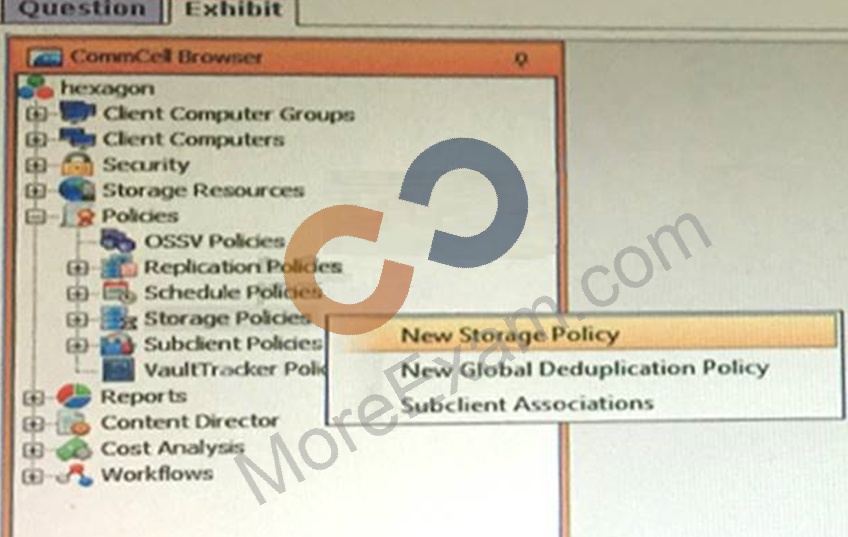
You have a SnapProtect v11 environment as shown in the exhibit.
What are the two default Snapshot copies created automatically after creating a Storage Policy. (Choose two.)

Question58: In clustered Data ONTAP, you are creating MirrorAndVault XDP relationships between existing primary and secondary volumes. The Snapshot copy policies have already been created and assigned.
The peering is already established and functional.
In clustered Data ONTAP, which three actions should be taken? (Choose three.)

Question59: You have set up a SnapMirror relationship between two SVMs for data protection. The data in the source volume is unavailable due to an event related to a virus infection leading to data corruption.
In this scenario, which three actions are required to activate the SnapMirror destination volume and provide data access to the users? (Choose three.)

Question60: You need to use SnapMirror on a SnapLock compliance source volume for a disaster-recovery site. In this scenario, which feature is supported for the destination volume?

Question61: You have a VMware VSphere environment with SRM and NetApp SRA fully configured.
Which two statements are true? (Choose two.)